 |
Tobacco-related disparities strategies – 10/19/09
Q: The Office on Smoking and Health (OSH) is compiling specific information on strategies that states/organizations are using to address tobacco-related disparities. The information will be used to inform the field about work being done to address tobacco-related disparities and how states are organized to address tobacco-related disparities specifically around policy-based initiatives.
Please tell us:
- Does your state or any partner organizations in your state have networks targeting specific groups experiencing tobacco-related disparities? If so, what populations?
- Does your state, or partner organizations in your state, implement any tobacco prevention and control programs that target specific populations? If so, please indicate the target populations and briefly describe the programs, especially any policy-based initiatives.
A:
- Colorado: The Colorado Department of Public Health and Environment funds eleven grantees to target 9 populations disparately affected by tobacco through the Tobacco Disparities Initiatives. All Colorado tobacco control partners work with at least one of the priority populations and on policy initiatives. Click here for a summary of the policy efforts and coalitions of the Tobacco Disparities Initiatives. These include a network developed by community-based organizations and local health agencies to work with Latinos across the state, through five regional coalitions, to implement the group’s strategic plan.
The tobacco disparities grantees collaborate with local health agencies (LHAs) and funded contractors, and serve on the Tobacco Disparities Advisory Committee (TDAC) of the Tobacco Education, Prevention, and Cessation Grant Program Review Committee to address policy priority areas and operationalize the Tobacco Disparities Strategic Plan. TDAC also serves as a place for the disparities grantees to come together and act as a unified voice. This group is essential for tobacco control in Colorado to help move policy initiatives forward, as well as to ensure the resulting policies and tobacco programming are culturally appropriate.
Due to limited geographic distribution, mainly within the larger metropolitan areas, many of Colorado’s disparately affected populations are better served by what may commonly be called coalitions.
True networks that serve target populations throughout the state are the SmokeFree GLBT Tobacco Project and the Latino Statewide Tobacco Education and Prevention Network grantees. These programs operate as networks because their target populations are diverse within the groups and must be served in communities throughout the state.
- District of Columbia: The District of Columbia’s Department of Health, Tobacco Control Program has networks targeting specific populations through its partnership with DC Tobacco Free Families Campaign, a community based organization. The populations targeted are youth, African American, Latino and Lesbian, Gay, Bisexual, Transgender.
Youth - Provided personalized and targeted tobacco use prevention outreach to out of school/high risk youth and District youth through partnership with Team Champions. Team Champions is a youth advocate group located in two inner city high schools that promotes healthy behavior and habits to their peers throughout the city. Team Champions reached out to local youth organizations and conducted the Toxic Soup presentation, worked with DC Parks and Recreation and Planned Parenthood to conduct youth oriented events. Black and Milds brochures were developed and distributed to youth. Paul Spiers, from Team Champion developed a PSA on SHS that aired on the radio for several months.
The Nasty is a 45 minute educational program, including a four ½ minute rap video, designed to promote critical thinking and stimulate discussion about how the tobacco industry has targeted youth as replacement smokers with enticing marketing strategies and illustrate the adverse physical and social effects of tobacco use. Local high school students are showcased and participated in the production of the Nasty Video. The educational video is designed for youth in the community groups in addition to middle and high school health and physical education classes. The program tool includes a DVD of Nasty and a Facilitators’ Guide for the class instructor.
An amendment was drafted to the DC Municipal Regulations regarding smoking in the District of Columbia Schools (DCPS) that included 100% tobacco free schools (public, private and parochial), nicotine and nicotine products.
The campaign, titled “Stupidiota”, a word made up by combining “Stupid” and the Spanish word “Idiota” (Idiot), is a mix of mass media and grassroots elements consisting of two TV spots that look like electronic games, “SIMS” and “WoW”, and one radio jingle, “Illusions”, that will be airing on English and Spanish TV stations as well as posters and stickers that will be distributed at community events and fairs. The campaign was created by Elevation, a leading Spanish ad agency in Washington, DC, based on youth culture and use of electronic games and was developed after conducting a research of media consumption habits by Latinos and urban minority youth.
African American - Conducted a Tobacco Summit for healthcare providers in relationship to youth and infants. Organized and facilitated the DC Tobacco Free Holy Grounds Initiative and provided tobacco use prevention to 8 faith based organizations. Provided personalized and targeted tobacco use prevention outreach and carbon monoxide screen pre and post test to the District’s medically underserved African American population in Wards 5 through 8. A former Redskins player, Darrell Green promoted quit smoking through TV commercials and personal greeting on the quitline.
Latino - Disseminated culturally and linguistically appropriate cessation materials and information about cessation programs and resources through quitline, healthcare providers, and community events. Conducted carbon monoxide screen pre & post test for the Latino community in Ward 1. Three provider trainings were conducted at Latino healthcare clinics, Mary’s Center, Upper Cardozo and Community of Hope. Educational videos were also installed in the health clinics’ waiting rooms promoting the quitline. The Latino material was developed with insertion of a local number to promote quitline to the Spanish-speaking community. Metro ads were launched at 8 area metro and bus stops. Established a coalition of Latino organizations and those that serve them to provide outreach material and cessation products through the Mary’s Center.
Lesbian, Gay, Bisexual, Transgender (LGBT) - Provided tobacco outreach services to the LGBT adult community. Carbon monoxide screen pre & post test and smoking cessation groups for the LGBT and HIV communities were conducted. A coalition of LGBT organizations was established. The population was provided with culturally sensitive outreach materials and cessation products through the Mautner Project and DC Center. Materials were distributed at Black Pride events. A metro campaign was launched to target population.
- Idaho: Idaho does not have any specific networks in the state targeting specific populations experiencing tobacco-related disparities. We work with the Northwest Tribal Cancer Coalition (which is supported by the Northwest Portland Area Indian Health Board) for issues around tobacco and cancer among Idaho Tribes.
We contract with four of the six Tribes in Idaho for tobacco prevention and control. A portion of that contract is focused on locally determined policy-based initiatives. We contract with the Idaho Commission on Hispanic Affairs and their TEENS coalition. A portion of that contract has a policy focus. We have several outreach and countermarketing programs that are focused on the state's LGBTQ population.
- Iowa: The IA Dept. of Public Health, Tobacco Division does have five networks set up as of July 1, 2008 for these populations:
- African American
- Asian Pacific Islander
- Hispanic/Latino(a)
- Native American
- Lesbian/Gay/Bisexual/Transsexual people
The above mentioned networks are all working on policy initiatives for health clinics that serve their populations. The networks are also involved in reaching health professionals that serve their populations. The Asian Pacific Islander, LGBT and African American networks are also working on community and faith based policy change. All policy change is directed to tobacco-free policy change.
All networks have action plans based on the best practices. They are catered to address cultural and linguistic barriers.
- Louisiana: The Louisiana Tobacco Control Program (LTCP) and The Louisiana Campaign for Tobacco‐Free Living (TFL) developed the Louisiana Tobacco‐Related Health Disparities Strategic Plan. Due to limited resources, we streamlined our targets to include five ethnic groups and specific groups that are crosscutting. The plan’s work group, now known as the Tobacco‐Related Health Disparities Coalition’s, mission is to address and eliminate tobacco in target populations including:
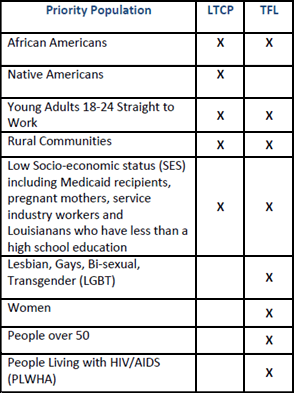
We developed a tobacco prevention and control program targeting priority populations in collaboration with Louisianans and stakeholders including the Department of Health and Hospitals, Community‐based organizations, and tobacco prevention partners such as the American heart Association, the American Cancer Society, the American Lung Association, Louisiana Head Start, and the American Legacy foundation. Our sister organization, TFL, also implements programs targeting priority populations. Please see the attached PDF for a listing of our programs.
- South Dakota: We have identified and target five specific groups for tobacco-related disparities:
- American Indians
- Medicaid clients
- Pregnant women
- Smokeless tobacco users
- Youth and young adults
We have pre-emption in our state, which means our hands are tied regarding any policy-based initiatives for these disparate populations with the exception of our American Indian tribes as they are their own sovereign nations and state law does not apply to them; and K-12 schools as it is against the law for this age group to use tobacco products. What we can provide is:
-
American Indians: We have grants with American Indian partners to provide commercial tobacco prevention and control for SD tribes.
-
Medicaid clients: We target tobacco users and work to educate them on the health risks of tobacco use and exposure to second-hand smoke.
-
Pregnant women: We have a media campaign called “I will keep you safe” to reinforce the health risks to the baby when mom uses tobacco during pregnancy. We provide all new mothers in the state with a baby bib which has the message “Little lungs need clean air too” We also provide funding for the Head Start program for SD tribes, which works to improve pregnancy outcomes for very high risk pregnancies.
-
Smokeless tobacco users: We fund several community coalitions which are very active in the rodeo community and provide tobacco prevention education at rodeo events.
-
Youth and young adults: We fund school-based tobacco prevention and control for curriculum, activities and tobacco free policy.
- Texas: Texas does not have any state networks targeting disparate groups. All of the DSHS funded community tobacco prevention and control programs have as a goal the elimination of tobacco-related health disparities, but we do not have programs that designed to specifically target a specific population.
- West Virginia: This information is readily available to CDC/OSH from the WVBPH Division of Tobacco Prevention’s (WVDTP) Annual Action Plan (pages 13, 14). WV has an existing statewide advisory board for disparities, program advisory committees individually address special population group needs, and an existing Program Strategic Plan is in place addressing Special and At-Risk Populations. Click here for a summary, “Identifying and Eliminating Tobacco-Related Disparities.”
- Wisconsin: Click here to download the Wisconsin Tobacco Prevention & Control Program tobacco-related disparities information.
Back to Table of Contents
|
|





















